
Practical Steps That Actually Work for Middle-Class Indians – No Gimmicks, Just Results
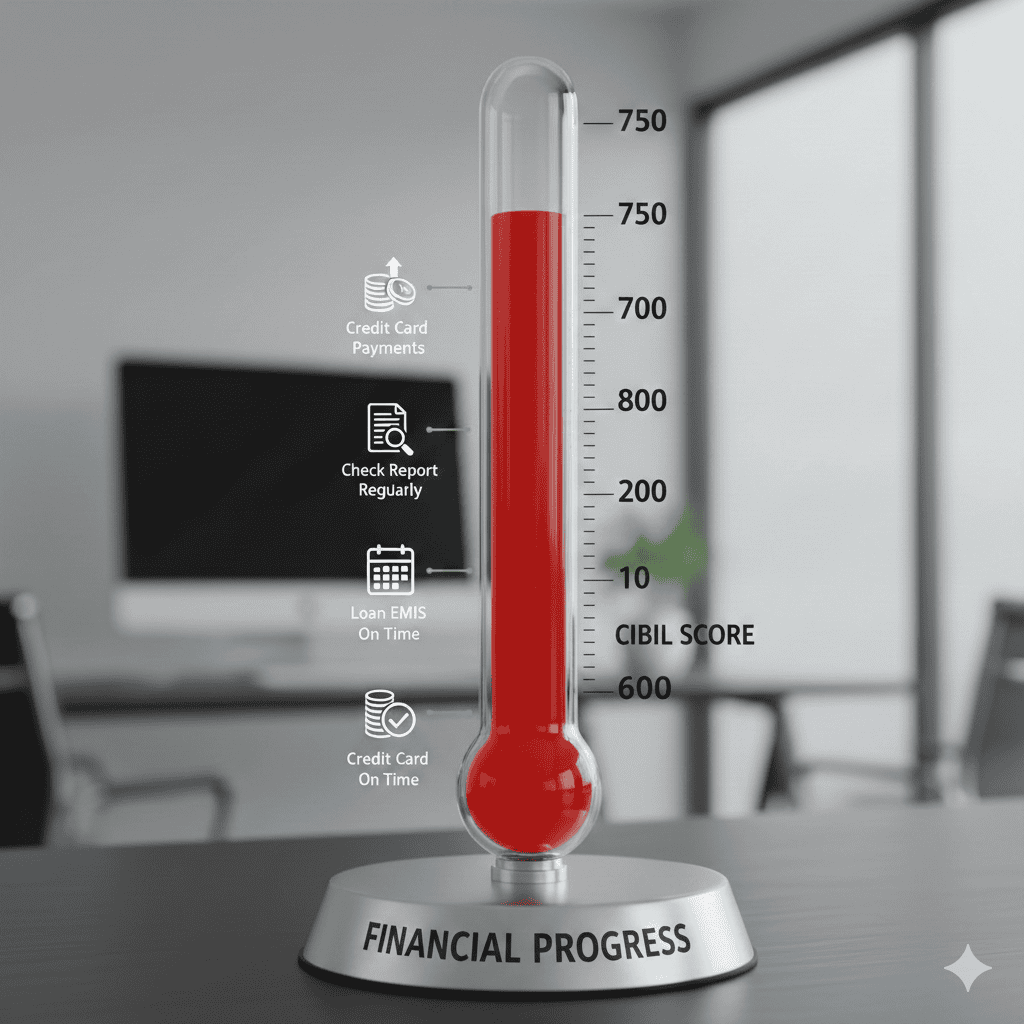
Scene 1: Raj applied for a home loan. Bank said: “Your CIBIL is 620. Interest: 9.5%. Down payment: 30%.”
Scene 2: Same Raj, 8 months later. CIBIL: 760. Same bank: “Interest: 8.4%. Down payment: 20%.”
The difference?
- Interest saved: ₹7 lakhs on ₹50 lakh loan over 20 years
- Down payment saved: ₹5 lakhs immediately
- Total benefit: ₹12 lakhs
Your CIBIL score isn’t just a number. It’s your financial reputation. In India, it determines:
- Loan interest rates (difference of 1-3%)
- Credit card limits
- Insurance premiums
- Even some job opportunities
If your score is below 700, you’re paying extra lakhs over your lifetime. Let’s fix that.
Part 1: What Your CIBIL Score Actually Means (Indian Context)
The 5 Components Simplified:
1. Payment History (35%) – Your “Punctuality Report Card”
- Pays on time = Good student
- Pays late = Teacher’s note to parents
- Defaults = Failed the year
2. Credit Utilization (30%) – Your “Money Management Skill”
- Using 30% of limit = Smart spender
- Using 80% of limit = Desperate appearance
- Using 100% = Red flag
3. Credit History Length (15%) – Your “Experience Certificate”
- 5-year old card = Trusted employee
- 1-month old card = New intern
- No credit history = No experience certificate
4. Credit Mix (10%) – Your “Versatility Score”
- Credit card + Personal loan + Home loan = Versatile player
- Only credit cards = One-trick pony
- No credit = Can’t assess versatility
5. New Credit (10%) – Your “Desperation Meter”
- 1 loan application this year = Planned need
- 5 applications in 3 months = Desperate behavior
Part 2: The 6-Month CIBIL Improvement Plan (Phase-by-Phase)
Month 1-2: The Foundation Phase (Score: 600-650)
Week 1-2: Assessment & Cleanup
- Get FREE CIBIL report: Use OneScore, CRED, or Paisabazaar
- Check for errors: Wrong personal details, duplicate accounts
- List ALL debts: Cards, loans, BNPL with amounts & due dates
- Set up calendar alerts: 7 days before EVERY due date
Week 3-4: Payment Discipline
- Pay ALL current dues FULLY (not minimum)
- If struggling: Use 50-30-20 rule for debt repayment
- Contact lenders if genuinely unable – ask for restructuring
- Close unused credit cards (after paying balance)
Month 3-4: The Building Phase (Score: 650-700)
Credit Utilization Strategy:
- If you have ₹1 lakh limit, spend max ₹30,000/month
- Pay multiple times a month to keep utilization low
- Request credit limit increase (only if using <30% current limit)
- Example:
- Current: ₹50,000 limit, ₹40,000 spent (80% utilization) = BAD
- Goal: ₹1,00,000 limit, ₹25,000 spent (25% utilization) = GOOD
Credit Mix Improvement:
- If only credit cards: Get small personal loan (₹50,000) for education/medical
- If only loans: Get basic credit card (FD-backed if needed)
- Avoid: Multiple new applications at once
Month 5-6: The Optimization Phase (Score: 700-750+)
Advanced Strategies:
- Become authorized user on spouse’s/parent’s old card (inherits their history)
- Keep old accounts open (even if not using – shows long history)
- Space credit applications: Minimum 6 months between applications
- Monitor regularly: Check score monthly (soft inquiries don’t affect score)
Part 3: Common CIBIL Myths That Actually HURT Your Score
Myth 1: “No Credit History = Perfect Score”
Truth: No history = No score = HIGH RISK for banks
Solution: Start with FD-backed credit card or small loan
Myth 2: “Checking My Score Lowers It”
Truth: Soft inquiries (your own checks) = NO impact
Hard inquiries (bank/lender checks) = Small temporary impact
Check monthly via free apps – it shows you’re responsible
Myth 3: “Closing Old Credit Cards Improves Score”
Truth: CLOSING old cards = REDUCES credit history length = LOWERS score
Better: Keep old card with ₹0 annual fee, make 1 small purchase yearly
Myth 4: “I Paid Default, It Should Disappear”
Truth: Defaults stay for 7 years from settlement date
But: “Settled” looks better than “Written off”
Action: After paying default, add note: “Settled as agreed”
Myth 5: “CIBIL Can Be Fixed by Agents for ₹5000”
SCAM ALERT: No one can remove genuine defaults
They do: Dispute genuine entries → Gets removed temporarily → Comes back next month
You lose: ₹5000 + Time + False hope
Part 4: Real Indian Case Studies
Case 1: The Young Professional (Age: 26, Starting Score: 580)
Problem: 3 credit cards, all maxed out. Multiple late payments.
Solution:
- Consolidated debt with personal loan (lower interest)
- Closed 2 cards after paying off
- Set up auto-pay for remaining card
- Used only 20% of limit
Result: 580 → 720 in 8 months
Case 2: The Family Man (Age: 42, Starting Score: 610)
Problem: Home loan EMI bounced twice. Credit cards rarely used.
Solution:
- Got basic credit card (against FD)
- Used for groceries, paid full monthly
- Built 12-month emergency fund to prevent EMI bounce
- Became joint account holder on wife’s old card
Result: 610 → 740 in 10 months
Case 3: The Business Owner (Age: 38, Starting Score: 590)
Problem: Business loan defaults during COVID. Multiple lender inquiries.
Solution:
- One-time settlement with lenders
- Waited 6 months, then got secured credit card
- Built business credit separately
- Kept personal and business finances separate
Result: 590 → 690 in 12 months (slower but steady)
Part 5: The Emergency CIBIL Fix (When You Need Loan in 30 Days)
Situation: “My CIBIL is 650. I need car loan next month.”
30-Day Emergency Plan:
Week 1:
- Pay ALL credit card balances to under 30% utilization
- Get credit report, dispute any errors immediately
- Pay any small outstanding bills (even ₹500 matters)
Week 2:
- Become authorized user on family member’s old, clean card
- If you have old default, try “goodwill deletion” letter to lender
- Don’t apply for ANY new credit
Week 3-4:
- Choose ONE lender, apply (multiple applications hurt)
- Consider offering collateral or higher down payment
- Get co-applicant with good score if possible
Important: This is emergency fix. Real improvement takes 6+ months.
Part 6: Tools & Resources for Indians
Free CIBIL Check Platforms:
- OneScore App: Free monthly score + analysis
- CRED: For credit card users, shows score impact of actions
- Paisabazaar: Free score + loan eligibility check
- Bank Websites: Many offer free score to customers
CIBIL Dispute Process:
- Step 1: Download report from CIBIL website (₹550, worth it for disputes)
- Step 2: Identify errors (wrong amounts, duplicate accounts)
- Step 3: Raise dispute online (takes 30 days)
- Step 4: Lender investigates, updates if error
Monthly Tracking Sheet:
Date   | Score | Change | Reason                    | Action Taken
-------|-------|--------|---------------------------|--------------
Jan 1  | 620   | -      | Starting point            | Got report
Jan 30 | 635   | +15    | Paid all dues on time     | Continue
Feb 28 | 650   | +15    | Reduced utilization to 40%| Aim for 30%
Part 7: Your 6-Month CIBIL Improvement Checklist
Month 1 Checklist:
- Get current CIBIL report
- List all debts with due dates
- Set up payment reminders
- Pay all current dues fully
- Dispute any errors found
Month 2 Checklist:
- Reduce credit utilization below 50%
- Close unused credit cards (if no annual fee issue)
- Check score improvement
- Create debt repayment plan if needed
Month 3 Checklist:
- Utilization below 40%
- All payments on time (100% track record)
- Consider credit mix improvement
- Review progress, adjust strategy
Month 4 Checklist:
- Utilization below 30%
- 4 months perfect payment history
- Consider becoming authorized user
- Monitor for errors/identity theft
Month 5 Checklist:
- Utilization below 25%
- Credit history building well
- No new credit applications
- Score should be 700+
Month 6 Checklist:
- Utilization 20-30% consistently
- 6 months perfect payments
- Good credit mix established
- Score 730-750+ achievable
Part 8: When CIBIL Isn’t the Problem
Other Credit Bureaus in India:
- Experian
- Equifax
- CRIF High Mark
Different lenders check different bureaus. If one score is low, check others.
Non-CIBIL Factors That Affect Loan Approval:
- Income Stability: 2+ years same job/business
- Debt-to-Income Ratio: EMI/income < 50%
- Employment Type: Government > MNC > Private > Business
- Age: 30-50 optimal
- Existing Relationship with Bank: Salary account helps
The Bottom Line: Patience & Consistency
CIBIL improvement is like weight loss:
- Quick fixes don’t last
- Consistency beats intensity
- Small daily habits create big results
- Setbacks happen – don’t quit
Your score is your financial health report. A good score means:
- Lower interest costs (saves lakhs)
- Faster loan approvals
- Better negotiation power
- Financial peace of mind
Your Action Steps TODAY:
- Check your CIBIL score (free on OneScore/CRED)
- Download your report if score < 700
- Identify ONE thing to fix this week (pay due, reduce utilization)
- Set 6-month reminder to check progress
Share in comments: Your current CIBIL score (if comfortable) and one thing you’ll improve this month. No judgment – we’re all learning!
Next in this series: “How to Read Your CIBIL Report Like a Banker” – decoding every code and column.
Leave a Reply