
Don’t Wait Till March – This December Checklist Could Save You ₹50,000+ in Taxes AND Improve Your Financial Health.
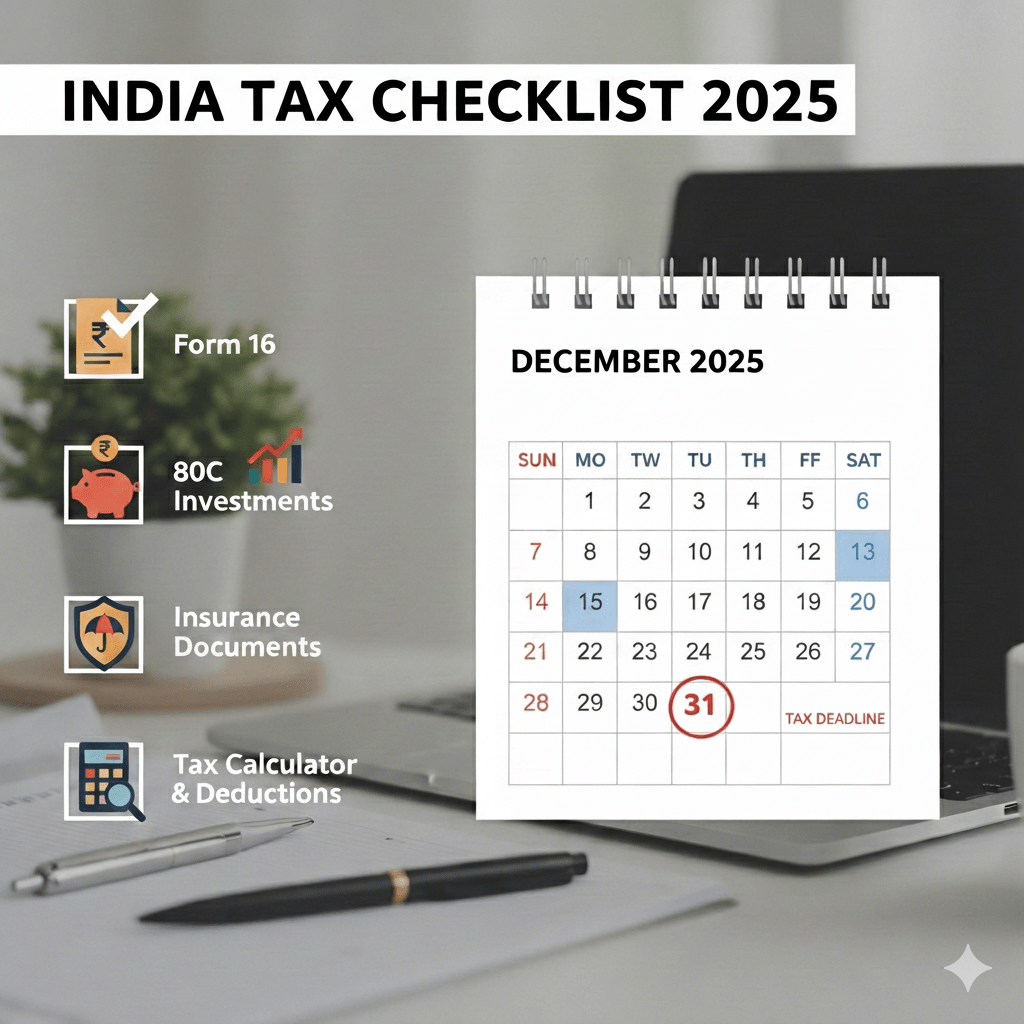
Scene 1: March 28, 2026. Rohan is frantically calling his agent: “Bhaiya, ₹1.5 lakh invest karana hai, 3 din mein! Koi bhi scheme bata do!” He invests in the first plan shown, pays extra commission, and gets subpar returns.
Scene 2: Same Rohan, but today – December 2025. He calmly reviews this checklist, makes strategic decisions over 3 months, saves ₹47,000 in tax, AND gets better investment returns.
The difference? 97 days of planning vs 3 days of panic.
If you’re an Indian earning more than ₹7 lakhs/year, this December could save you ₹20,000-₹50,000 in unnecessary tax payments next year. More importantly, it could prevent you from making ₹2-5 lakh worth of bad financial decisions in March madness.
Grab your coffee and 30 minutes. Let’s build your December Tax Action Plan together.
Part 1: The 3 Tax Personalities – Which One Are You?
Type 1: The March Madness Maker (80% of Indians)
- Action: Last-week panic investing
- Result: Wrong products, high commissions, poor returns
- Tax Saving: Yes, but wealth destruction: ₹1 lakh investment → ₹85,000 value in 3 years
Type 2: The January Planner (15% of Indians)
- Action: January planning, February-March execution
- Result: Better choices, but limited time for research
- Tax Saving: Good, wealth preservation: ₹1 lakh → ₹1.1 lakh in 3 years
Type 3: The December Strategist (5% of Smart Indians)
- Action: December planning, spreading investments Jan-Mar
- Result: Best products, cost averaging, optimal returns
- Tax Saving: Excellent, wealth creation: ₹1 lakh → ₹1.3 lakh+ in 3 years
This post will help you become Type 3. The goal isn’t just tax saving – it’s tax-efficient wealth building.
Part 2: Your December Tax Checklist (10 Action Items)
✅ CHECK 1: Calculate Your Exact Tax Liability TODAY
Why: You can’t plan what you don’t measure.
How to Calculate:
- Gross Salary: Check December payslip
- Existing Deductions: HRA, LTA, Standard Deduction already considered
- 80C Investments Already Made: PF, life insurance premiums, etc.
- Other Investments: 80D (health), 80CCD(1B) (NPS), etc.
Simple Formula:
Taxable Income = Gross Income - (Standard Deduction + HRA + LTA + Already claimed deductions)

Remaining 80C Space = ₹1,50,000 - (PF + Insurance + Other 80C investments)

Tax Liability = Calculate using new/old regime calculator
Action: Use any online income tax calculator.
✅ CHECK 2: New Regime vs Old Regime – FINAL Decision
Critical: This choice affects ALL other decisions.
New Regime Wins If:
- Your total 80C+80D+other deductions < ₹3.75 lakhs
- You have simple income (mostly salary, minimal deductions)
- You’re under 40 with fewer liabilities
Old Regime Wins If:
- You have home loan (Section 24 + 80EE benefits)
- You invest regularly in ELSS, PPF, insurance
- Your total deductions > ₹4 lakhs
- You have family health insurance (80D)
December Action:
- Calculate tax under BOTH regimes
- Choose ONE and stick with it for entire FY
- Inform employer NOW for correct TDS
✅ CHECK 3: Home Loan Interest Certificate
Deadline: Request by December 31 from bank.
Why: Section 24 (up to ₹2 lakh interest deduction) + Section 80EEA (extra ₹1.5 lakh for first-time buyers).
Documents Needed:
- Loan statement (April 2025 – March 2026 projected)
- Interest certificate (will come in January)
- Principal repayment proof (for 80C)
Action This Week:
- Email bank: “Please send interest certificate for FY 2025-26”
- Mark calendar: Follow up on January 15 if not received
✅ CHECK 4: Health Insurance Review & Top-up
Section 80D Benefits:
- Self/Family: ₹25,000 (under 60) / ₹50,000 (senior)
- Parents: ₹25,000/₹50,000 extra
- Total possible: ₹1,00,000 deduction
December Actions:
- Check existing coverage: Is it enough post-COVID? (Minimum ₹10 lakh recommended)
- Top-up if needed: Super top-up plans are cost-effective
- Parents’ insurance: Renew or purchase before March 31
- Preventive health checkup: ₹5,000 deduction (within above limits)
Pro Tip: Buy 2-year policies in December – often cheaper, and you lock in next year’s deduction too.
✅ CHECK 5: NPS – The ₹50,000 Bonus Deduction
Section 80CCD(1B): Extra ₹50,000 beyond 80C’s ₹1.5 lakh.
Who Should Consider:
- Already maxing 80C
- Age 35+ thinking about retirement
- Want extra tax saving with decent returns
December Action:
- Open NPS account if don’t have (via bank or online)
- Decide allocation: 50% equity if under 45, more debt if older
- Set up SIP: ₹4,167/month to reach ₹50,000 by March
- Don’t forget: This is locked till 60 (withdraw 60% tax-free)
✅ CHECK 6: Document Collection Marathon
Create These 3 Folders NOW:
Folder 1: Investment Proofs
- PPF passbook/statement
- ELSS mutual fund statements
- Life insurance premium receipts
- NSC certificates
- School tuition fees receipts (children)
Folder 2: Expense Proofs
- Rent receipts (with owner’s PAN if rent > ₹1 lakh/year)
- Home loan interest certificate
- Medical bills (for reimbursement claims)
- Charity donation receipts (80G)
Folder 3: Income Documents
- Form 16 (will come in April/June)
- Interest certificates from banks
- Capital gains statements
- Freelance income receipts
December Goal: Have 70% documents ready by December 31.
✅ CHECK 7: Capital Gains Planning
Scenario: You sold stocks/property in 2025.
December Actions:
- Calculate gains: Short-term vs long-term
- Set aside tax money: Don’t spend it thinking “I’ll manage later”
- Consider tax-saving bonds: 54EC bonds for property gains (save tax if invested within 6 months)
- Harvest losses: If you have loss-making investments, consider selling to offset gains
Important Dates:
- Property sale: Invest in 54EC bonds within 6 months of sale
- Equity sale: Pay advance tax by December 15 if liability > ₹10,000
✅ CHECK 8: Advance Tax Check
Who Pays Advance Tax:
- If tax liability > ₹10,000 after TDS
- Freelancers, business owners, landlords
- People with capital gains, interest income
December 15 Deadline: 3rd installment (75% of total tax)
Action:
- Calculate total expected income
- Subtract TDS already deducted
- Pay balance if > ₹10,000
- Use Challan 280 on income tax portal
Penalty: 1% monthly interest on unpaid advance tax. Don’t ignore!
✅ CHECK 9: Tax-Saving Investments – Smart Allocation
The December Strategy: Plan now, execute Jan-Mar.
Optimal 80C Allocation for Middle-Class:
- PF/VPF: Already happening, check if you can increase
- ELSS: 40-60% of remaining amount (start SIP in January)
- PPF: 20-30% (lump sum in March for compounding)
- Life Insurance: Only if you need coverage (not just for tax)
- Home Loan Principal: Already paid, get certificate
Golden Rule: Never buy insurance just for tax saving. Buy term insurance for protection, invest separately.
✅ CHECK 10: Family Finance Meeting
Last Sunday of December: 2-hour family meeting.
Agenda:
- Review checklist progress
- Assign responsibilities:
- Who collects which documents?
- Who follows up with bank/agent?
- Who maintains the folders?
- Set January 15 review date
- Celebrate completing the checklist!
Why Family? Because tax decisions affect everyone. Wife’s investments, children’s tuition fees, parents’ insurance – it’s all connected.
Part 3: The Month-by-Month Execution Plan
December (Planning Month):
- Week 1: Complete checks 1-5
- Week 2: Document collection starts
- Week 3: Make final decisions (regime, investments)
- Week 4: Family meeting, finalize plan
January (Action Month):
- Start ELSS SIP (better averaging than lump sum)
- Pay Q3 advance tax (if applicable)
- Follow up on pending documents
- Book preventive health checkup
February (Consolidation Month):
- Review investment progress
- Make PPF contribution
- Pay children’s tuition fees
- Complete health insurance purchases
March (Completion Month):
- Week 1: Final review
- Week 2: Make remaining investments
- Week 3: Submit proofs to employer (if possible)
- Week 4: Relax – you’re done!
Part 4: Common December Mistakes & How to Avoid
❌ Mistake 1: Buying Insurance for Tax Saving
Problem: ULIPs/endowment plans give 4-5% returns, charge 5-10% fees
Solution: Buy term insurance (if you need protection), invest in ELSS/PPF separately
❌ Mistake 2: Last-Minute ELSS Lump Sum
Problem: Investing ₹1.5 lakh on March 31 = no averaging, higher risk
Solution: Start ₹50,000 SIP in January across 3 months
❌ Mistake 3: Ignoring Home Loan Benefits
Problem: Not claiming Section 24 (₹2 lakh) + 80EEA (₹1.5 lakh extra)
Solution: Get interest certificate early, claim correctly
❌ Mistake 4: Wrong Regime Choice
Problem: Choosing new regime but having ₹4+ lakh deductions
Solution: Calculate both, choose wisely, stick to it
❌ Mistake 5: Not Informing Employer
Problem: High TDS deduction, refund wait
Solution: Submit investment declarations by January 31
Part 5: Special Cases
For Freelancers/Business Owners:
- Maintain books properly from Day 1
- Pay advance tax by December 15 (75%)
- Claim expenses legitimately (office, travel, phone)
- Consider presumptive taxation if turnover < ₹50 lakhs (44ADA)
For Senior Citizens:
- Higher 80D limit: ₹50,000 for self, ₹50,000 for spouse
- Senior Citizen FD: Extra 0.5% interest, but taxable
- Pension income: Standard deduction ₹50,000
- Medical expenses: Deduction for specific treatments
For Women Taxpayers:
- No extra benefits anymore (gender-neutral now)
- But: Plan jointly with husband for optimal family savings
- Important: File returns independently if income > basic exemption
For NRIs:
- Residential status matters (182 days rule)
- Different tax rates for Indian vs foreign income
- DTAA benefits: Avoid double taxation
- March 31 deadline same for everyone
Part 6: Your December Action Kit
Free Resources:
- Tax Calculator Google Sheet (Link below)
- Document Checklist PDF
- Month-by-Month Planner
- Regime Comparison Calculator
Apps to Help:
- Quicko/ClearTax: For calculations
- Google Keep/Evernote: Document tracking
- Calendar reminders: For deadlines
- Banking apps: For interest certificates
Professional Help When Needed:
- Hire CA if: Business income, capital gains > ₹10 lakh, foreign income
- Cost: ₹2,000-₹10,000 (saves headaches and penalties)
- Find: Through references, not random ads
Part 7: The December Pledge
Copy, paste in comments, and commit:
I, [Your Name], pledge to complete my tax planning in December 2025.

I will:
1. Calculate my exact tax liability by December 25
2. Choose the right tax regime by December 31
3. Collect 70% of my documents by December 31
4. Make smart investment decisions, not panicked ones
5. Involve my family in the process

I understand that:
"Early planning saves money AND stress.
Smart tax planning is wealth planning.
March is for execution, December is for strategy."

Signed,
[Your Name]
December 2025
Your This-Weekend Action Plan:
Saturday (3 hours):
- Hour 1: Calculate tax liability (Check 1)
- Hour 2: Decide tax regime (Check 2)
- Hour 3: Request home loan certificate & review insurance (Checks 3-4)
Sunday (2 hours):
- Hour 1: Start document collection (Check 6)
- Hour 2: Family meeting to assign tasks (Check 10)
Result: By Sunday night, you’ll be ahead of 90% of Indians in tax planning.
Questions? Confusions?
Ask in comments below! Our community and I will help with:
- Specific calculation problems
- Document confusion
- Investment choices
- Regime decisions
Pro Tip: Sort comments by “Newest” – answer someone else’s question. Teaching is the best way to learn!
Bookmark this page – return to it every weekend in December to track progress.
Share with 3 friends who also do March madness planning – save them money and stress!
Leave a Reply