
Sab Samjhein: Indian Finance Terms Explained in Simple Hindi/English
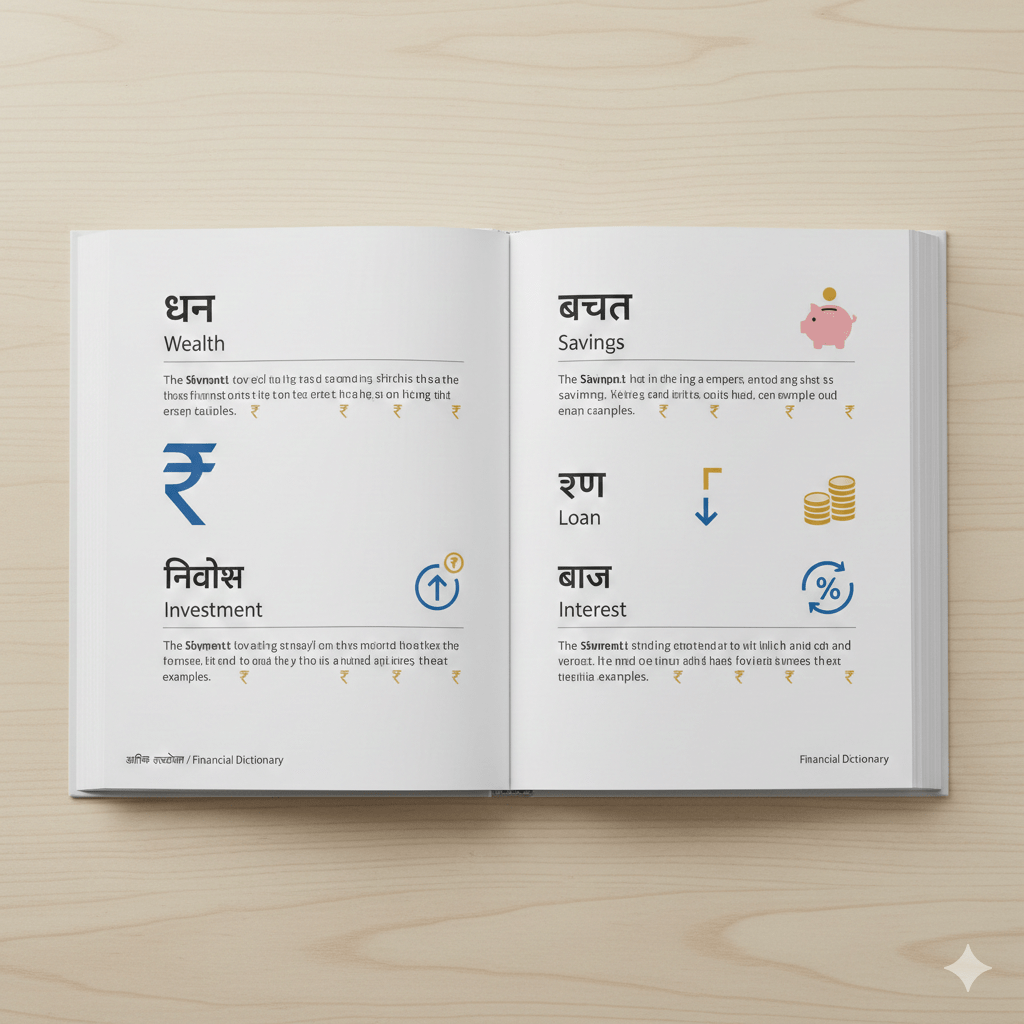
“Finance ki bhasha aasan hai – bus koi bataye to!” (Finance language is easy – if only someone explains!)
If you’ve ever nodded along when someone said “diversification” or “asset allocation” while secretly thinking “kya bol raha hai yeh?” – this page is for you.
Here, we break down 100+ Indian finance terms into simple language with real Indian examples. No complex English, no Western examples that don’t apply here. Just clear explanations for the average Indian.
📚 THE DICTIONARY (A-Z):
A
Asset Allocation (संपत्ति आवंटन)
What: How you divide money between different investments
Simple: “Your thali – some rice (safe), some sabzi (growth), some dal (balance)”
Indian Example: Young Indian = 60% stocks, 30% FDs, 10% gold
Related: Diversification, Portfolio
Annual Percentage Rate (APR) – वार्षिक प्रतिशत दर
What: Real cost of loan including all fees
Simple: “Loan ka asli mehengaai”
Indian Example: Personal loan says 12% but APR is 15% (processing fee + insurance included)
Watch For: Credit cards show “monthly 3%” but APR is 42% yearly!
B
Balance Transfer (बैलेंस ट्रांसफर)
What: Moving debt from high-interest card to lower-interest one
Simple: “Karza ek jagah se doosri jagah”
Indian Example: Move ₹1 lakh from HDFC (36%) to SBI (12% promo)
Tip: Check processing fee (usually 2-3%)
Bear Market (बेयर मार्कट)
What: When stock market falls 20%+ for long period
Simple: “Bhaav gir raha hai” (Prices falling)
Indian Example: 2008 global crisis, 2020 COVID crash
Opposite: Bull Market
C
CIBIL Score (CIBIL स्कोर)
What: Your credit report card (300-900)
Simple: “Bank ka bharosa score”
Good Score: 750+ (gets lower loan interest)
Improve: Pay on time, use <30% credit limit
Check Free: CRED, OneScore apps
Capital Gains (पूंजीगत लाभ)
What: Profit from selling investments
Types: Short-term (<1 year), Long-term (>1 year)
Tax: Shares – STCG: 15%, LTCG: 10% over ₹1 lakh
Example: Bought stock ₹100, sold ₹150 = ₹50 capital gain
D
Demat Account (डीमैट खाता)
What: Digital locker for shares/mutual funds
Simple: “Share ka Gmail”
Cost: ₹200-300/year
How to open: Zerodha, Upstox, Groww (online, 10 minutes)
Myth: “Only for experts” – False, SIP investors need it too
Debt Fund (डेब्ट फंड)
What: Mutual fund investing in loans/bonds
Simple: “FD se behtar, stock se safe”
Returns: 6-8% (better than FD after tax)
Best for: Money needed in 1-3 years
Examples: Liquid fund (emergency), Short-term debt fund (goals)
E
ELSS (Equity Linked Savings Scheme)
What: Mutual fund for tax saving under 80C
Simple: “Tax bachao, paisa badao fund”
Lock-in: 3 years (shortest in 80C)
Risk: Medium (invests in stocks)
Start: ₹500/month SIP
Best for: Young earners wanting growth + tax saving
Emergency Fund (आपातकालीन निधि)
What: 6 months expenses kept safe
Simple: “Neend ki goli” (Sleeping pill)
Where: Liquid mutual funds (not FD)
Amount: Monthly expenses × 6 + ₹1 lakh buffer
Example: ₹30k/month expenses = ₹2.8 lakh emergency fund
F
Fixed Deposit (FD) – सावधि जमा
What: Money locked in bank for fixed period
Simple: “Safe, par inflation se piche”
Interest: 5-7% (taxable)
Better Option: Debt funds for 3+ years (tax efficient)
Senior Citizen FD: 0.5% extra interest
Financial Year (FY) – वित्तीय वर्ष
What: April 1 to March 31 (India)
Simple: “Tax wala saal”
Important Dates:
- July 31: Tax filing deadline (if audit not needed)
- March 31: Last day for tax-saving investments
Remember: FY 2024-25 = April 1, 2024 to March 31, 2025
G
Gold ETF (गोल्ड ईटीएफ)
What: Paper gold traded like stocks
Simple: “Gold without locker worry”
Vs Physical: No making charges, no safety issues
Better Option: Sovereign Gold Bonds (SGBs) – give 2.5% extra interest
Start: ₹1000 via Zerodha/Groww
Gratuity (ग्रेच्युटी)
What: Lump sum from employer after 5+ years service
Simple: “Loyalty bonus”
Formula: (Last salary × 15/26) × Years of service
Example: ₹50,000 salary × 5 years = ₹1.44 lakhs (tax-free!)
Note: Only if company has 10+ employees
H
HRA (House Rent Allowance) – घर किराया भत्ता
What: Salary component for rent
Tax Exempt: Minimum of:
- Actual HRA received
- 50% salary (Metro) / 40% (Non-metro)
- Actual rent – 10% salary
Must: Submit rent receipts to employer
Pro Tip: Even if living with parents, pay rent and claim (with proper agreement)
Health Insurance Top-up (हेल्थ इंश्योरेंस टॉप-अप)
What: Extra cover after basic limit exhausted
Simple: “Double protection”
Example: Company gives ₹3 lakh, buy ₹10 lakh top-up
Cost: ₹5-10k/year for family
Important: Covers COVID, pre-existing after waiting
I
Index Fund (इंडेक्स फंड)
What: Mutual fund copying Nifty/Sensex automatically
Simple: “India growth fund”
Cost: 0.1% vs 1-2% for regular funds
Start: ₹500 SIP in Nifty 50 Index Fund
Philosophy: “If India grows, my money grows”
Inflation (मुद्रास्फीति)
What: Prices rising over time
Simple: “₹100 ki ab ₹90 ki value”
India Average: 5-6% yearly
Meaning: FD at 6% = 0% real return
Beat It: Need equity investments (10-12% returns)
J
Joint Account (संयुक्त खाता)
What: Bank account in multiple names
Types: “Either or Survivor” (anyone can operate), “Former or Survivor” (first holder operates)
Simple: “Husband-wife ka common khata”
Use For: Household expenses, joint goals
Tax: Both pay tax on interest proportionally
Junk Bonds (जंक बॉन्ड)
What: High-risk, high-return bonds
Simple: “Risk ka satta”
Avoid: As beginner
Indian Context: Very limited availability
Better: Stick to government bonds, AAA corporate bonds
K
KYC (Know Your Customer) – ग्राहक को जानें
What: Identity verification process
Simple: “Aadhaar-PAN verification”
Where Needed: Bank accounts, mutual funds, trading
eKYC:* Online via Aadhaar OTP
Documents: PAN, Aadhaar, address proof
Once KYC, everywhere: KYC done for mutual funds works for all funds
Kisan Vikas Patra (किसान विकास पत्र)
What: Government savings scheme
Simple: “Double money in 10 years scheme”
Interest: ~6.9% (changes quarterly)
Lock-in: 2.5 years (partial withdrawal allowed)
Tax:* Interest taxable
Best For:* Risk-averse, medium-term goals
L
Liquid Fund (लिक्विड फंड)
What: Mutual fund investing in very short-term debt
Simple: “Savings account se behtar”
Withdrawal:* 24 hours
Returns:* 5-6% (better than savings account)
Use For:* Emergency fund, parking short-term money
Example:* Axis Liquid Fund, Mirae Asset Cash Management
LTCG (Long Term Capital Gains) – दीर्घकालीन पूंजीगत लाभ
What:* Tax on profits from investments held long-term
For Stocks:* >1 year holding
Tax:* 10% on gains over ₹1 lakh/year
Example:* Bought shares ₹2 lakh, sold after 2 years ₹3 lakh = ₹1 lakh gain = No tax (within exemption)
Save:* Hold investments >1 year to pay less tax
M
Mutual Fund (म्यूचुअल फंड)
What:* Pooled money professionally managed
Simple:* “Bus mein safar” (You sit, expert drives)
Types:* Equity (stocks), Debt (bonds), Hybrid (mix)
Start:* ₹500 SIP via Groww/Zerodha
Myth:* “Need lakhs” – False, start with ₹500
Microfinance (सूक्ष्म वित्त)
What:* Small loans to low-income individuals
Simple:* “Chhota karza unbanked ko”
Interest:* 18-24% (higher risk)
Regulated by:* RBI
Famous:* Bandhan Bank (started as MFI)
N
NPS (National Pension System) – राष्ट्रीय पेंशन प्रणाली
What:* Government pension scheme
Simple:* “PF ke alawa extra pension”
Tax Benefit:* Extra ₹50,000 under 80CCD(1B)
Withdrawal:* 60% at 60 (tax-free), 40% must buy annuity
Start:* ₹500/month via bank
Nifty 50 (निफ्टी ५०)
What:* Index of India’s 50 biggest companies
Simple:* “India ka business health meter”
Companies:* Reliance, HDFC, TCS, Infosys, etc.
Invest:* Via Index Funds (₹500 SIP)
Philosophy:* “Bet on India’s growth”
O
Overdraft (ओवरड्राफ्ट)
What:* Borrow from bank account beyond balance
Simple:* “Khata mein se zyada nikalna”
Limit:* Usually 50% of FD value
Interest:* Only on used amount
Better than:* Personal loan for short-term needs
Example:* ₹1 lakh FD = ₹50,000 overdraft facility
Operating Expense Ratio (OER) – परिचालन व्यय अनुपात
What:* Mutual fund’s yearly management cost
Simple:* “Fund manager ki fee”
Range:* 0.1% (Index funds) to 2.5% (small cap funds)
Impact:* 2% fee = ₹20,000/year on ₹10 lakh
Choose:* <1% for large cap funds
P
PPF (Public Provident Fund) – लोक भविष्य निधि
What:* Government-backed, tax-free savings
Simple:* “Sarkari safe investment”
Tenure:* 15 years (extendable)
Interest:* ~7.1% (tax-free)
Limit:* ₹1.5 lakh/year
Best For:* Retirement, child’s future
Power of Attorney (POA) – वकालतनामा
What:* Legal right to act for someone
Simple:* “Kisi ke liye kaam karne ka hak”
Types:* General (all matters), Specific (one task)
For Investing:* Needed for trading accounts sometimes
Risk:* Give only to trusted person
Q
Quarterly Results (त्रैमासिक परिणाम)
What:* Company’s financial results every 3 months
Simple:* “Company ka har 3 mahine ka report card”
Months:* Jan-Mar (Q4), Apr-Jun (Q1), Jul-Sep (Q2), Oct-Dec (Q3)
Check For:* Profit growth, debt levels, future guidance
Where:* Moneycontrol, Screener.in
Quick Ratio (त्वरित अनुपात)
What:* Company’s ability to pay short-term debts
Simple:* “Emergency fund for companies”
Formula:* (Cash + Receivables) / Current Liabilities
Good:* >1
Example:* Company with ₹2 crore cash+receivables and ₹1.5 crore debts = 1.33 (healthy)
R
Recurring Deposit (RD) – आवर्ती जमा
What:* Monthly fixed deposit
Simple:* “Monthly Bachat Yojana”
Interest:* Similar to FD (5-7%)
Start:* ₹100/month
Use For:* Building habit, small goals
Better Option:* SIP in debt fund (more tax efficient)
Reverse Mortgage (रिवर्स मोर्टगेज)
What:* Get monthly income against house
Simple:* “Ghar se pension”
For:* Senior citizens (60+)
Amount:* 40-60% of property value paid monthly
Repayment:* After death, heirs repay or bank sells property
Banks Offering:* SBI, Punjab National Bank
S
SIP (Systematic Investment Plan)
What:* Fixed amount invested regularly
Simple:* “Netflix subscription par paisa badao”
Benefits:* Removes timing risk, builds discipline
Start:* ₹500/month
Myth:* “Need perfect timing” – SIP removes this need
Power:* ₹5000/month for 30 years at 12% = ₹1.7 crore
SEBI (Securities and Exchange Board of India)
What:* Stock market regulator
Simple:* “Share bazaar ki police”
Role:* Protect investors, regulate companies/brokers
Website:* sebi.gov.in (verify brokers here)
Helpline:* 1800 22 7575
T
Term Insurance (टर्म इंश्योरेंस)
What:* Pure life cover (no investment)
Simple:* “Sasta, par sukoon wala insurance”
Cost:* ₹500-1000/month for ₹1 crore (age 30)
Tenure:* Till 60-85 years
Must Have:* If you have dependents
Avoid:* ULIPs as insurance (costly, complex)
TDS (Tax Deducted at Source) – स्रोत पर कर कटौती
What:* Tax deducted before you receive income
Simple:* “Pehle hi kat gaya tax”
Examples:* Salary (employer deducts), FD interest (bank deducts)
Form 26AS:* Shows all TDS (check on income tax portal)
Claim:* While filing ITR if excess deducted
U
ULIP (Unit Linked Insurance Plan)
What:* Insurance + Investment mix
Simple:* “Do kam ek saath” (but costly)
Charges:* High (5-10% first year)
Better Option:* Term insurance + Separate mutual funds
Avoid:* As beginner
Only If:* You understand charges and have high risk appetite
Unsecured Loan (असंपत्ति ऋण)
What:* Loan without collateral
Simple:* “Bina ghar-gadi girvi loan”
Types:* Personal loan, credit card debt
Interest:* Higher (10-24%)
Approval:* Based on CIBIL score, income
Example:* Medical emergency loan
V
Valuation (मूल्यांकन)
What:* Determining company’s worth
Simple:* “Company kitne ka hai?”
Metrics:* P/E ratio (Price/Earnings), P/B ratio (Price/Book)
Example:* Company earns ₹10/share, stock price ₹200 = P/E 20
Rule:* Lower P/E often better (but check industry average)
Volatility (अस्थिरता)
What:* How much price fluctuates
Simple:* “Upar-neeche hona”
High Volatility:* Small cap stocks
Low Volatility:* Large cap stocks, FDs
For Beginners:* Choose lower volatility investments first
W
White Label ATM (व्हाइट लेबल एटीएम)
What:* ATM not owned by bank
Simple:* “Private company ka ATM”
Operators:* Tata, Hitachi
Charges:* May have extra fees after free transactions
Identify:* Logo of operator (not bank)
Will (वसीयत)
What:* Legal document for asset distribution after death
Simple:* “Mere baad yeh sab kisiko milega”
Must For:* Property owners, investments, business
Cost:* ₹2000-5000 (lawyer) or free format online
Without Will:* Court decides (lengthy process)
X
XIRR (Extended Internal Rate of Return)
What:* Return on irregular investments
Simple:* “SIP ka real return calculator”
Use For:* Calculating mutual fund returns with multiple transactions
Formula in Excel:* =XIRR(cash flows, dates)
Example:* You did SIP for 2 years, withdrew some, want actual return
Y
Yield (यील्ड)
What:* Income from investment as percentage
Simple:* “Kitna mila percentage mein”
Types:* Dividend yield (stocks), Interest yield (FDs)
Example:* Stock price ₹100, dividend ₹5 = 5% yield
Not Same as:* Total return (includes price growth)
Z
Zero Coupon Bond (जीरो कूपन बॉन्ड)
What:* Bond sold at discount, pays face value at maturity
Simple:* “Discount par khareedo, full price par becho”
Example:* Buy for ₹800, get ₹1000 after 5 years
Tax:* Interest is implied, taxable yearly
Indian Example:* RBI Bonds, some corporate bonds