
From ₹15 Lakh Debt to Freedom in 3 Years – A Real Indian Family’s Journey
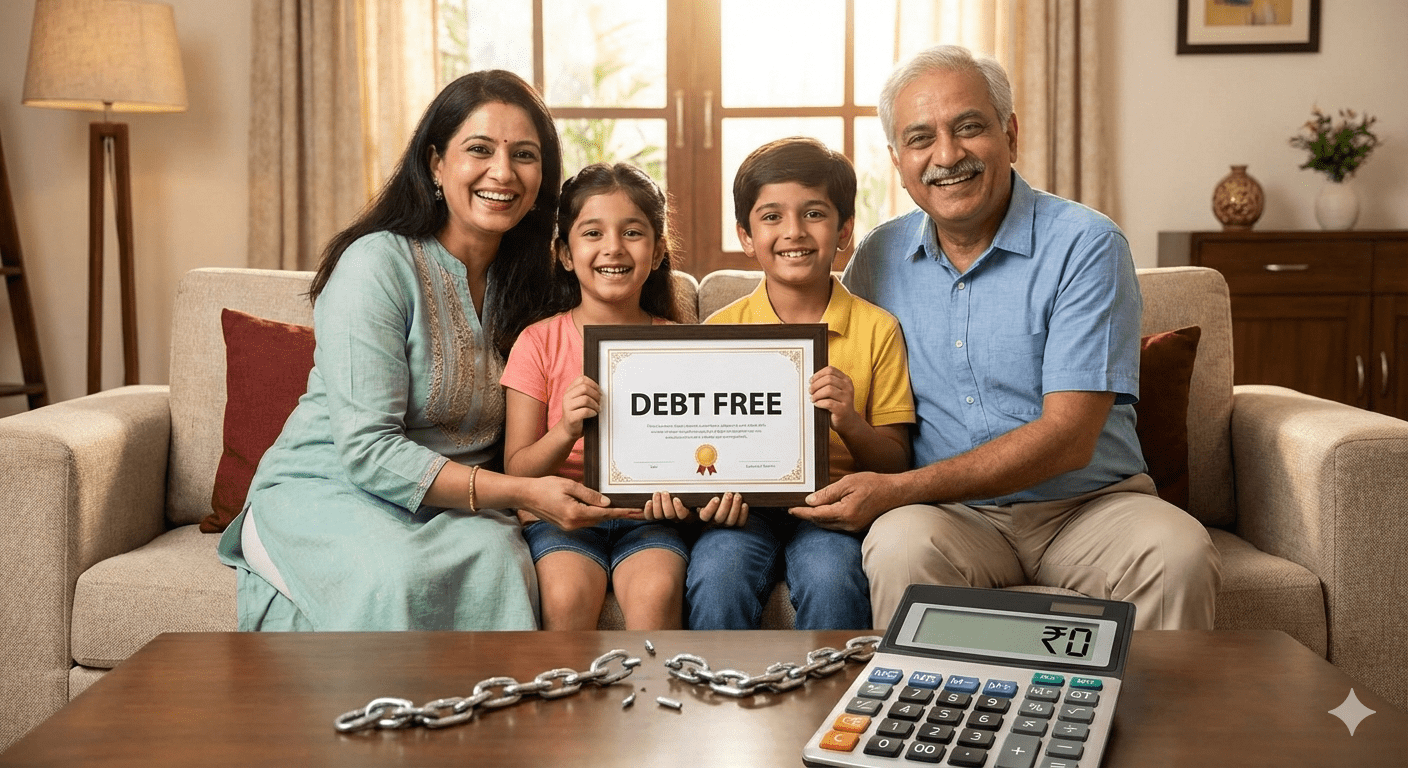
December 2022: The Mehtas owed ₹15.7 lakh – home loan ₹12L, car loan ₹3L, credit cards ₹70k. Monthly EMIs: ₹42,000. Stress level: Maximum.
December 2025: Total debt: ₹0. Monthly EMI: ₹0. Emergency fund: ₹6 lakh. Stress level: Minimum.
The difference? Not a lottery win. Not inheritance. A systematic 5-step strategy any Indian family can follow.
If your EMIs eat 40%+ of salary, if you juggle credit cards to pay bills, if debt discussions cause family fights – this blueprint is your roadmap to freedom.
Part 1: The Debt Reality Check – Calculate Your TRUE Situation
The Indian Debt Trap Formula:
Monthly EMI/Income Ratio = (Total EMIs ÷ Take-home Salary) × 100

Safe: <30%
Danger: 40-50%
Critical: >50% (You're one emergency from default)
Your Homework (10 minutes):
- List ALL debts with: Balance, Interest, EMI, Tenure
- Calculate total monthly EMI outflow
- Divide by your take-home salary
- Face the number honestly
Example:
- Salary: ₹75,000
- Total EMIs: ₹34,500
- Ratio: (34,500 ÷ 75,000) × 100 = 46% (Danger Zone)
Part 2: The 5-Step Freedom Framework
Step 1: The Debt Freeze (Month 1)
Rule: NO new debt for 90 days.
- Cut up store cards
- Delete card from online shopping
- Use cash/debit for essentials
- Communicate with family: “We’re on a 90-day mission”
Psychological Benefit: Breaking the debt-acquisition habit.
Step 2: The EMI Optimization (Month 2)
A. Balance Transfers:
- Credit card debt > ₹50,000? Transfer to lower-interest card
- Look for 0% balance transfer offers (6-12 months)
- Caution: Don’t use freed limit for more spending!
B. Loan Restructuring:
- Home loan >5 years old? Check current rates vs yours
- Refinance if difference >0.5%
- Consider shifting to another bank
C. Tenure Extension (Temporary):
- Increase home loan tenure to reduce EMI
- Use the difference to pay higher-interest debts
- Example: ₹40,000 EMI → ₹35,000 (save ₹5,000 for credit card)
Step 3: The Avalanche vs Snowball Debate
Avalanche Method (Mathematically Optimal):
- List debts by interest rate (highest first)
- Pay minimum on all, extra on highest interest
- Saves more interest
Snowball Method (Psychologically Powerful):
- List debts by balance (smallest first)
- Pay minimum on all, extra on smallest
- Quick wins build momentum
Indian Hybrid Approach:
- Start with Snowball (2-3 small debts)
- Switch to Avalanche for large debts
- Why? Early motivation matters more than perfect math
Step 4: The 50-30-20 Adjustment
Normal Budget: 50% Needs, 30% Wants, 20% Savings
Debt Attack Budget: 50% Needs, 20% Wants, 30% Debt Repayment
Where to find extra 10%:
- Eating out ₹5,000 → ₹2,500 (save ₹2,500)
- Entertainment ₹3,000 → ₹1,500 (save ₹1,500)
- Shopping ₹4,000 → ₹2,000 (save ₹2,000)
- Miscellaneous ₹3,000 → ₹1,500 (save ₹1,500)
Total Monthly: ₹7,500 extra for debt
Step 5: The Income Boost
Side Hustle Rule: 100% of side income goes to debt.
Realistic Indian Options:
- Weekend tuition: ₹8,000-₹15,000/month
- Freelance projects: ₹10,000-₹25,000/month
- Online consulting: ₹5,000-₹20,000/month
- Part-time work: ₹15,000-₹30,000/month
The Math: ₹15,000 side income × 24 months = ₹3.6 lakh debt reduction.
Part 3: The Indian Case Study – ₹15.7L to ₹0 in 36 Months
The Mehta Family (Names Changed):
Starting Point (Jan 2023):
- Home Loan: ₹12L @8.5% (EMI: ₹28,500)
- Car Loan: ₹3L @10.5% (EMI: ₹9,500)
- Credit Cards: ₹70k @36% (Min due: ₹4,000)
Total EMI: ₹42,000 (56% of ₹75,000 salary)
Their 5-Step Execution:
Month 1-3: Foundation
- Transferred credit card to 0% offer card
- Cut discretionary spending by 40%
- Started weekend tuition (₹12,000/month)
- Created visual debt tracker on fridge
Month 4-12: Attack Phase
- Paid off credit card completely (Month 5)
- Refinanced car loan (10.5% → 9%)
- Increased home loan EMI by ₹3,000
- Side income to ₹18,000/month
Month 13-24: Momentum
- Car loan closed (Month 18)
- Celebrated with debt-free car trip
- Increased home loan prepayment
- Built ₹2 lakh emergency fund
Month 25-36: Final Push
- Home loan closed (Month 35)
- Total interest saved: ₹4.2 lakh
- Debt freedom party with close family
Part 4: Special Indian Scenarios
Scenario 1: Multiple Credit Card Debt
Strategy:
- Stop using ALL cards immediately
- Negotiate with banks for lower interest
- Consolidate into personal loan if rate <15%
- Use balance transfer offers strategically
Negotiation Script: “I want to pay but struggling. Can you reduce interest or waive charges? Otherwise I might default.”
Scenario 2: Home Loan + Other Debts
Priority Order:
- Credit card debt (36-49% interest)
- Personal loan (10-18% interest)
- Car loan (8-12% interest)
- Home loan (8-10% interest)
Why home loan last? Lowest interest, tax benefits continue.
Scenario 3: Business Debt Personal Guarantee
Critical: Separate business and personal finances immediately.
- Open separate business account
- Document all business expenses properly
- Consider business debt restructuring
- Personal assets protection planning
Part 5: The Emotional & Family Aspect
The Weekly Money Meeting:
Every Sunday, 30 minutes:
- Review progress (use visual tracker)
- Celebrate small wins (debt reduced by ₹10,000? Small treat!)
- Discuss challenges openly
- Plan next week’s spending
Sample Tracker:
Jan 2026: Debt: ₹12,45,000
Feb 2026: Debt: ₹11,90,000 ✓ Reduced ₹55,000!
Mar 2026: Debt: ₹11,20,000 ✓ Reduced ₹70,000!
Handling Social Pressure:
Indian weddings/festivals during debt repayment:
- Be honest: “We’re on a debt freedom mission this year”
- Set boundaries: “We can contribute ₹X, not ₹Y”
- Alternative gifting: Homemade gifts, time instead of money
- Remember: True relationships understand financial responsibility
Part 6: When to Seek Professional Help
Red Flags (Get Help If):
- Using new loans to pay old loans
- Missing EMI payments regularly
- Hiding debt from spouse
- Debt causing health issues
- Legal notices received
Professional Options in India:
- Credit Counselling: Non-profit organizations
- Debt Management Companies: Check RBI registration
- Legal Help: For severe cases, loan restructuring
- CA/Financial Planner: For business debt situations
Avoid: “Debt settlement” companies charging upfront fees. Legitimate help doesn’t ask for money first.
Part 7: Your 90-Day Debt Freedom Launch Plan
Week 1-2: Assessment & Planning
- Complete debt inventory
- Calculate debt-to-income ratio
- Choose snowball or avalanche method
- Family meeting to commit
Week 3-4: Optimization
- Balance transfers if applicable
- Expense reduction plan
- Side income brainstorming
- Create visual tracker
Month 2: Execution
- First extra payment made
- Side hustle launched
- First milestone celebration
- Adjust plan as needed
Month 3: System Building
- Habits solidified
- Progress reviewed
- Next 3 months planned
- Emergency fund started
Join “Indian Debt Freedom Warriors” community – Share progress, get motivation, find accountability partners!
Share your debt freedom story anonymously – Your journey inspires others! 👇
Important Disclaimer:
This is educational content. For severe debt situations, consult certified credit counsellors or financial advisors. Debt restructuring has credit score implications. Individual results may vary.
Leave a Reply